_edited.png)
FUE vs. FUT Scar Comparisons
The fundamental difference between surgical techniques lies in how hair follicles are extracted from the donor site—and consequently, how the donor area heals and appears over time. The following side-by-side comparisons cover immediate scarring, long-term healing, worst-case scenarios, and concealment methods —giving you the complete picture of what to expect from each approach.
Donor Site Appearance Immediately After Surgery
FUE 1.0
(Traditional FUE - 1.0mm Punch)
FUE 1.0 requires shaving a large donor area to perform the surgery, leaving no hair to cover the extraction sites. The punched holes are visible for several days after surgery.

Immediately after FUE 1.0 Surgery

Immediately after FUE 1.0 Surgery
FUE 2.0
(0.9mm Precision Punch)
FUE 2.0 still requires shaving the donor area, but the smaller 0.9mm punch creates extraction sites that are nearly invisible within seven days after surgery.

Immediately after FUE 2.0 Surgery

7 days after FUE 2.0 Surgery
FUT 2.0
(via HUMS Protocol)
Only a 2cm-wide strip area is shaved, and a 1cm strip is removed, leaving a 1cm shaved area. As long as donor site hair is at least 3cm in length, the shaved area is covered and undetectable immediately after surgery.

Immediately after FUT 2.0 Surgery

Immediately after FUT 2.0 Surgery

FUE 2.0 Grafts with Surrounding Tissues. The smaller punch does not compromise quality.
Comparing Scar Size: FUT 2.0 vs. FUE
FUT 2.0 Scar
Following the HUMS protocol significantly decreases the size the FUT linear scar, allowing hair to grow within the scar tissue.
-
For a donor area of 20 cm², the resulting scar measures approximately 1 mm × 20 = 2 cm².
-
A key advantage of FUT 2.0 is that it promotes hair growth within the scar, as evidenced in photos.
FUE 1.0 Scar
For the same amount of hair extraction, equivalent to 2000 FUE grafts, the scar size calculation is as follows:
-
Using a 1 mm punch, each scar has an area of 0.5×0.5×π=0.78 mm²
-
Total scar area for 2000 grafts: 2000×0.78=1560 mm²=15.6 cm²
This means the total FUE scar area is 789% larger than the FUT 2.0 (HUMS) scar.
Key Observations
1. FUT 2.0 Scar Advantage
Unlike FUE scars, which remain permanently devoid of hair, FUT 2.0 via the HUMS Protocol allows hair to regrow within the scar tissue itself — minimizing visibility even with short hairstyles.
2. FUE Scar Expansion
The actual FUE scar size often exceeds the punch diameter due to two factors:
-
Scalp tension — the open wound stretches as the scalp heals, enlarging each extraction site
-
Hair angle — hair rarely grows perpendicular to the scalp. The more acute the angle of hair growth, the larger the visible scar footprint
Long-term Donor Site Scars
FUE Scar Size
For 3,000 grafts, FUE 2.0 will leave thousands of tiny scars totaling approximately 30 cm².
FUE Scar with Shaved Head
Thousands of individual punch scars may be visible across the donor area.

FUE Scar with Short Hair
When hair is worn short, FUE extraction sites are barely visible as multiple small dots distributed across the donor area.


FUE Scar with Fade Haircut
Fade haircuts require gradual tapering, which means the donor area will be cut progressively shorter. The harvesting area needs to be 8-10cm wide to accommodate this style, which increases the risk of visible scarring at the lower portion of the fade where hair is shortest.

FUT 2.0 Scar Size
For 3,000 grafts, FUT 2.0 leaves a 30 cm long by 0.1 cm wide scar, totaling approximately 3 cm² (one-tenth the total surface area of FUE 2.0).
FUT 2.0 with Shaved Head
(via HUMS Protocol)
A single linear scar is faintly visible.

FUT 2.0 with Short Hair
(via HUMS Protocol)
The linear scar remains nearly invisible because hair grows directly through the scar tissue. Even with short hair, the scar is difficult to detect.
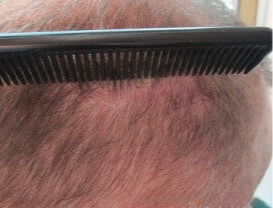

FUT 2.0 with Fade Haircut
(via HUMS Protocol)
Only a 1cm-wide harvest area is needed and it can be positioned in the higher, denser portion of the permanent zone, allowing fade haircuts to have minimal scar visibility.

Worst Case Scenarios
FUE 1.0 - Poor Outcome Example
Issue: Harvesting from too small an area.
When the extraction area is insufficient for the number of grafts needed, the donor site can appear visibly thin and patchy. This occurs because the cumulative scarring (even from small punches) becomes concentrated in a limited area.

FUT 1.0 - Poor Outcome Example
Issue: Wide, visible linear scar without hair growth.
Traditional strip harvesting often resulted in scars 2-4mm wide with no hair growth through the scar tissue. While this creates only one linear scar, it can be visible even at moderate hair lengths.

FUE 1.0 - Risks to Harvesting Beyond the Safe Zone

Issue: Extraction from non-permanent hair areas.
FUE 1.0 procedures often harvest from a wide area, extending beyond the "safe zone" of genetically permanent hair. As patients age, both the transplanted hair from these areas and the surrounding donor hair may be lost, exposing thousands of extraction scars.
Scar Concealment Methods
Covering FUE Scar
-
Hair Length - Keeping hair longer can provide coverage. The donor area may still appear thinner than surrounding areas because extraction scars remain open (not closed like FUT incisions), creating a larger cumulative scar area.
-
Camouflage Products - Hair fibers, powders, and concealers can temporarily mask the appearance of thinning in the donor area.
-
Scalp Micropigmentation (SMP) - Medical tattooing can create the illusion of hair density by adding pigment dots across the extraction sites. For FUE, this involves treating the thousands of small scattered punch scars.
Covering FUT 2.0 Scar
-
Hair Length - Moderate to longer hair lengths provide complete coverage. Because hair grows through the scar tissue itself, the donor area maintains natural density even with the scar present.
-
Hair Color Foundation - or those who prefer very short hair, matching foundation can be applied to the narrow linear scar area.
-
Scalp Micropigmentation (SMP) - Medical tattooing can create the illusion of hair density by adding pigment dots across the extraction sites. If desired, pigmentation can be applied to the single linear scar for additional concealment. For FUT, this treats only one narrow line rather than multiple scattered sites.
Medical Tattoo Procedure: Before vs. After

Immediately Prior to
Tattoo Procedure

Immediately After
Tattoo Procedure